![VS-Logo-1.jpg]](https://support.vsware.ie/hs-fs/hubfs/VS-Logo-1.jpg?height=40&name=VS-Logo-1.jpg)
Accessing the Behaviour Module
To access Behaviour as an administrator:
-
Go to Overview in the main menu.
-
Click on Behaviour.
-
A left-hand navigation menu will appear with several Behaviour-related sections.
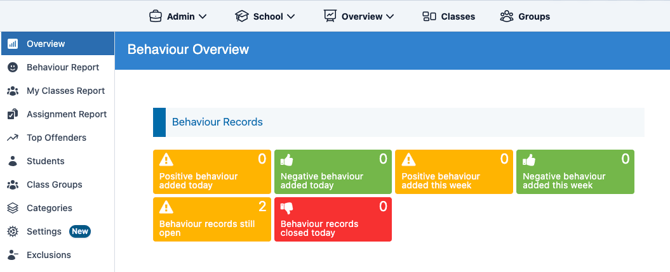
The first seven items in this menu relate to different types of behaviour reporting. These are covered in the full Behaviour Reporting Guide.
Behaviour Categories
To begin setting up a behaviour from scratch, click Overview > Behaviour > Categories.
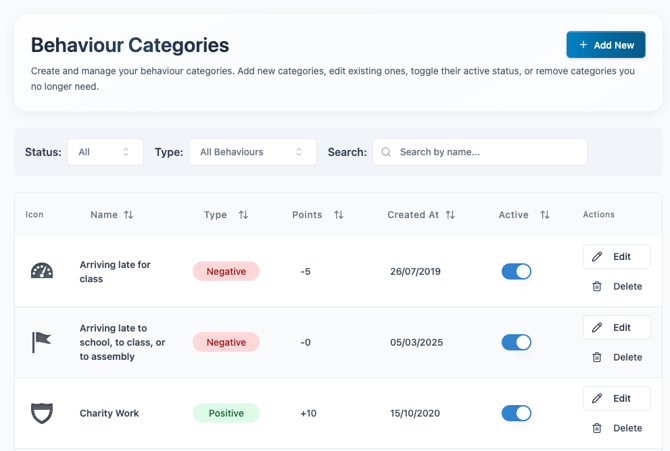
The Categories screen has been redesigned with improved navigation and filtering tools.
-
Status Filter – Filter by whether a behaviour category is currently active or inactive.
-
Type Filter – Filter between positive or negative behaviours.
(A “neutral” type will be added in the coming months.) -
Search Bar – Quickly locate a specific category by name.
-
Edit / Delete Options – Manage existing categories directly from the list.
Creating a New Behaviour Category
To add a new behaviour type for staff to use:
-
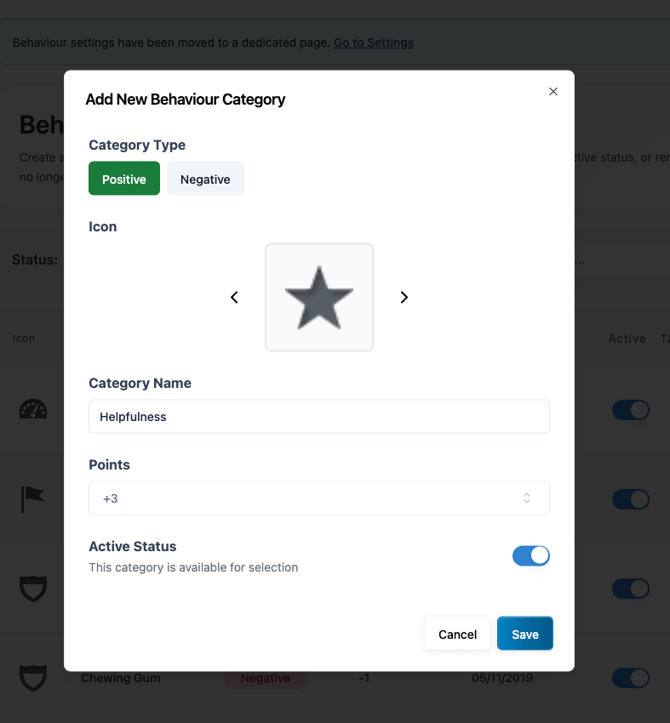
Click Add New.
-
Choose whether this behaviour is Positive or Negative.
-
Select an Icon to represent the behaviour.
-
Enter the Name of the behaviour.
-
Assign a Point Value:
-
Positive numbers increase a student’s score.
-
Negative numbers reduce a student’s score.
-
Select Zero if you are not using a points based system.
-
Click Save.
The new behaviour category will now be available for recording across the school.
Behaviour Settings (New)
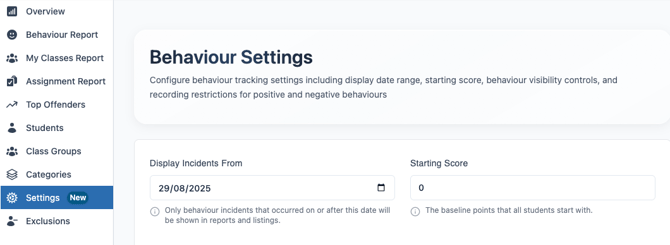
A new Settings page allows schools to configure how behaviour tracking works. It allows you to:
Set a date for showing behaviour incidents:
-
Only incidents that occurred on or after the selected date will appear in listings and reports.
Set the baseline points that all students begin with.
eg.
-
0 – standard baseline.
-
+100 – if your school uses a positive-balance system.
-
–100 – for schools using a deduction-based structure.
This applies school-wide.
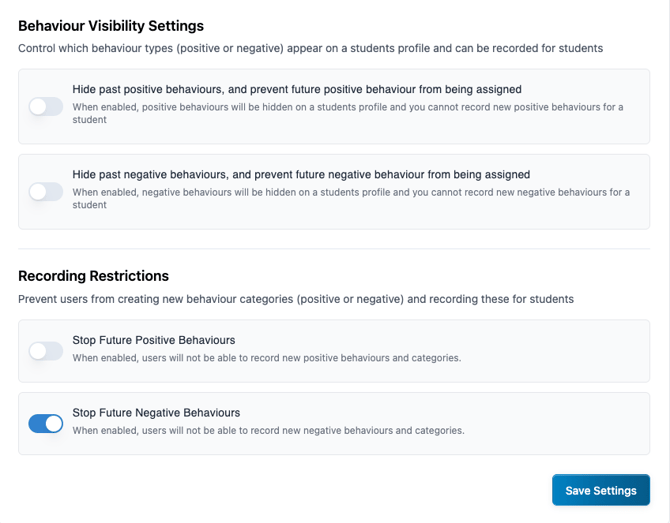
Visibility Settings
Control which types of behaviour (positive or negative) are:
-
Visible on a student’s profile.
-
Recordable by staff.
You can choose to:
-
Hide past positive behaviours and prevent new ones from being assigned.
-
Hide past negative behaviours and prevent new ones from being assigned.
-
Use this to tailor your school’s approach, for example, removing negative behaviour entirely for a fully positive-reinforcement model.
Important:
If you change these settings, ensure colleagues are informed so everyone understands the new behaviour rules.
Note:
Turning off visibility does not delete any past behaviour. All historic records remain available through reporting tools; they are simply hidden from the live profile and cannot be used when recording.
5. Effect on Student Profiles
Once visibility and recording settings are applied:
-
Only the allowed behaviour types will appear on a student’s Behaviour tab.
-
Staff will be unable to assign any behaviour category that has been restricted (e.g., negative behaviours if they have been disabled).
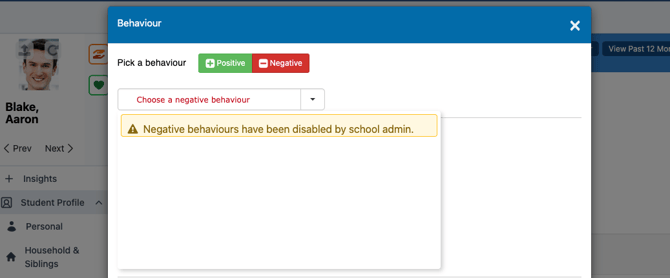
This ensures the system accurately reflects your school’s policy.